David Winters; Infinite Fictions: Essays on Literature and Theory; Zero Books, 2015
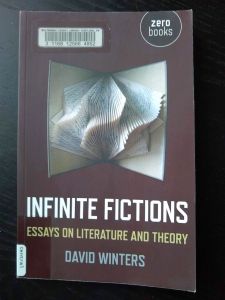
As a self-taught student of literature and theory, the internet has been my university. Easy access to the wide array of considerate writing and thoughts concerning contemporary literature, art and culture has been invaluable. As any reader that avails themselves of this sphere will know, the webs and pathways created through this source can widely open one’s awareness and pursuit of so much material that otherwise would perhaps remain distant, foreign, overwhelming. The “ivory tower” remains distant, impenetrable, self-concerned. And thus, from the interconnected and referential world of online critical output, I am grateful when I learn of books such as Infinite Fictions by David Winters. Such a book is quite refreshing because, whereas I quite enjoy the click-and-consume aspect of digital culture, bringing home a book of insightful, relevant and forward moving pieces such as this one unites the two sides of my reading life.
These short essays, or reviews, on contemporary literature and theory are so far excellent, in that Winters has the ability to create perceptive, considerable readings of these works, while maintaining an accessibility I quite value. He is not attempting to write over his readers’ heads, to wow them with his obvious knowledge, but serves to construct a bridge to works otherwise less known, or perhaps, to offer alternate ways of considering these works when read. Of course, some of the authors are quite highly regarded: Lydia Davis, Sam Lipsyte, Gordon Lish, Gerald Murnane, but the majority are those working on the forefront of contemporary literature, mostly lesser-known (at least to the main current of American literature) and Winters introduces the books and offers interesting commentary, without falling into the academic practice of doing a paragraph-by-paragraph deep analysis of the texts, but also succeeds in doing more than giving us a simple gloss of each paragraph illustrated with generous chunks of quoted text (which can be useful, but oftentimes this style of review feels exhaustive and less insightful than I would like). Instead, there is a middle ground of considerable analysis and general review.
From his somewhat personal reflections in the introduction, which again, feels like a fresh and approachable stage for the following pieces, one gets the notion that Winters is a passionate reader and thinker of what he’s read, and it is that marvel, that connection to his own life and the reading life within, that he brings to this work. Essentially, it is enthusiasm for the enrichment critical thought brings, not enthusiasm for showing others his critical thought, that seems to give this collection value beyond the ideas contained within.
With more of the book to get through, I find myself excited to follow Winters’ considerations, and after a reading I feel myself invigorated to seek those pathways in my own reading.
 Material Archive