Jon Fosse; Morning and Evening; Trans. Damion Searls; Dalkey Archive Press, 2015
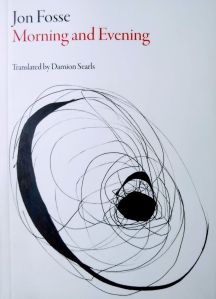
Three books into Fosse’s work, and it begins to feel like an immersion. The patterns of his language, the repetitions of his characters, the backdrop of fjords, silence and water. It is an enjoyable dive, one that fosters contemplation and self-removal; much in the way breath exercises bring about similar responses. Upon completion of this book, a surprising word came to mind: gentleness. I found myself surprised by this, it is perhaps not a word that gets associated too often with contemporary literature, particularly literature from other parts of the world, and certainly not with the books under the Dalkey Archive flag. And yet, Fosse handles life, death, love with not quite brazen sentimentality, but a kindness to his characters and to his own spiritual convictions.
Morning and Evening, relates the main character Johannes’ experience of the cycle of his own birth and death, and explores the betweenness of these poles in a compact and mesmerizing way.
Through what Fosse has written elsewhere, the context and execution of this meditation on the spiritual and corporeal is not surprising. Fosse is a spiritual person, who has related the mystical nature of the writing experience, and I get the sense that this work was a way for him to see how close he can get to the realm of spirits, memories, and afterlife. The simplicity and repetition of the prose, the recurring scenes and dialog, the deliberate use of subtle tension, (all techniques Fosse deploys as the very nature of his “style”) keep us from understanding this as simply a man’s ghost story.
In the first section, in stilted dialog and intense interior thought, full of closed space, primal sounds, and musings on God, the birth of Johannes is recounted. In the next section, the elderly Johannes wakes with a strange feeling, physically invigorated, lighter than he has come to expect. Johannes takes this as simply odd but good fortune. He wonders at the loneliness within his house and follows a regular morning routine of coffee, cigarettes and breakfast. From here the book moves into a quiet series of surreal experiences that fill in the moments of connectivity that give Johannes his sense of being in the living world. It is here, in these interactions, that Fosse opens the possibility of the spiritual realm and our human attachment to the earthen, comprised of, when it’s all said and done, of a few meaningful moments and human connections. This microcosm of our lived experience is really a part of our spiritual existence, and Fosse seems to be musing, that the line between the two spheres is not all that separate, however, to get to the space of this connecting thread, one must turn away from the world. As Johannes is going through his day-long journey, he is continually encountering the past, namely, Peter, his old friend whom he knows has passed, and Peter interacts with others that have passed, and then his deceased wife, Erna, and fishing with its associated memories. This looking away from the world has its ties to Fosse’s self-admitted influence from Norwegian Puritanism, and the notion of creating a private about-facing world in which one lives separate from the outer main world. Fosse seems to be writing this into being with Johannes’ final experiences, which cause him more confusion than anxiety.
And this is the gentle aspect of the work that struck me. The characters are creations of caring, kindness, gentleness, simplicity. In fact, the scene of most tension is experienced through the first living person depicted in the story, Johannes’ daughter, whose interaction with her father (his invisible spirit actually) unnerves her, the presence is even deemed evil by her. This deliberate portrayal of fear of the dark, unknowable division is key to Fosse’s use of the residual in his work. Memories, spirits, places all seem to haunt his turned-away worlds, and yet we know from Johannes’ perspective, there is not much fear. And the final concluding segment of this book, which simulates many television cliché portrayals of such scenes of “crossing over”, is so openly celebratory, not ironic or cynical, that one simply appreciates Fosse’s authorial openness to deliver what he presumably deemed his best artistic effort in writing about such matters as life, death, and the potential hereafter, and yes, Fosse’s sea is there till the end.
 Material Archive