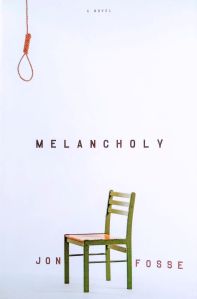
Jon Fosse; Melancholy; Trans. Grethe Kvernes & Damoin Searls; Dalkey Archive Press, 2006
I have come to consider the experience of reading Jon Fosse’s books as submersion. I mean by this the feeling associated with actual underwater submersion, in a lake, perhaps, where the bottom is not visible, nor is the mottled hues of brown, green, and black light in the water particularly welcoming. First there is the commitment to do so, which for me has always invoked a particular inflamed imagination verging into panic, but really the true difficulty, once under the water, is the inevitable opening of the eyes, to glimpse that aquatic, alien world, and the anticipation of what will be seen, or more dreadfully, not be seen. And yet, when a moment has passed, there is the undeniable, liberating, and peaceful feeling of floating in opaque darkness, there is an impression of true isolation that sparks a sense primal happiness. These conflicting elements of claustrophobia and airy expanse are the spiritual core of Fosse’s books, and to read through them all successively generates a similar reaction.
His work is dark, earthy, and menacing, but he equally achieves humor, spirit, and compassion. These qualities, certainly the heavy matter of great books, are also delivered in a distinct prose style that Fosse has made his own. I have come to see and read the blocks of repetitious text, made jagged by sparse lines of unquoted dialog, as bodies of water, and once the reader is fully invested, there is little to be done but move with the current. His books may feel to some as tedious, repetitive, or self-indulgent, but I would argue, to extend the aquatic metaphor, that to lower one’s shoulders beneath what seems a cold surface, will likely bring on a strange comfort; his strings of sentences, clauses and terse dialog become incantatory, penetrating, and the combination of this written approach with the spiritual tension present in his work, makes one feel as if they’ve just experienced an obscure ritual.
The tension of the secular and non-secular, or perhaps in less loaded phrases, the spiritual and the earthy, is the hallmark of Fosse’s oeuvre; some works verge overtly into the former, such as Morning and Evening, with its ghosts and afterlife elements, and others lean heavily into the latter, including Melancholy, a work that prods deeply and unrelentingly into human psyche as it exists in society.
Melancholy is unlike the other books, in that at 284 pages it is nearly three times the length. The other books, which I read before this one, are short blasts of experience, where signature Fossian traits seem to flash into the reading consciousness, whereas this title reads more like the slow burnout of a star, a condition that allows the residual matter to rest in growing layers on the mind. I found this text difficult at times, due to its length and repetitions, which seem to be more pronounced here than elsewhere, but this discomfort is enhanced by the fact that the “menacing” element is placed in the very foreground as opposed to its spatial presence in the other works. This element is the mental unhinging of the main character, Lars Hertervig, a Norwegian man studying painting in Germany. What at first reads as an energetic if slightly unstable monologue by a socially awkward (a common theme in Fosse is the very given awkwardness of social life) ego turns further and further into a full-blown mental collapse. It can be quite unpleasant at times, hearing in your mind as your read, the same disparaging or desperate, or vulgar remarks over and over again. These two components of the text, in the end, may slightly detract from its power, in the way a teasing game of tickling or poking becomes tedious then irritating. Though I believe Fosse could have achieved the same ultra-immersion into a difficult mental landscape with less, the extent of these detracting factors also, I realize after finishing the book, enhance the claustrophobic grip on the reader, making the inability to escape ultimate. Indeed, the last portion of the “Asylum Lars” [my title] section (there are three distinct narrative sections) focuses on this entrapment to such a degree, that the character ultimately resigns his pushback and gives into to his madness.
The three narrative sections of the book happen chronologically. The first and the majority of the book, brings the reader to Germany into the mind of Lars Hertervig (1830-1902), a historical figure in Norwegian Romantic landscape painting. On this particular day of the narrative, Lars is asked to leave the home in which he boards while undertaking his painting studies, a proposition his mind can barely grasp with, and it seems that possibly this request is the trigger that sets his mind cascading into a cyclical loop of paranoia, speculation, and outlandish behavior. The central interest of his, or rather his discomforting obsession, is the homeowner’s teenage daughter Helene, for whom his intense passion is repeatedly stated in his hyper-focused mind. This unhealthy relationship, likely quite one-sided and perhaps even a delusion, is the reason he’s asked to pack, and his reluctance to do so increases the tension in the home. The second point of contention is his total lack of comradeship among the other painters. As numerous as his professions of love are his disparaging remarks about the other students’ total lack of talent – the phrases “can’t paint” and “can paint” appear often. The degree to which his mind has loosened its grip becomes apparent when he begins to convince himself that the reason for his expulsion from the home is that his “girlfriend” is really more interested in having an incestuous affair with her uncle, the man behind the eviction. Lars wildly veers from love and caring of Helene to graphic accusation of her motives, and this all in his mind, while outwardly he typically says very little to those around, in fact its this juxtaposition of external paralysis and internal storm that makes his display of madness effective. At one point, the internal diatribe becomes heightened with Helene and he makes a random internal comment about killing her, and the reader knows that this is a new reality for Lars, a reality of conflicting realities. After a long shameful scene in a pub, the humiliation at the hands of his peers, Lars inexplicably attempts to return to the boarding house, where he is finally arrested.
The second section of the novel takes place in Gaustad Asylum in Norway, where Lars is a resident/patient. He has succumbed to the mental illness that wrecks his life (though not directly stated, it seems he suffers from a form of schizophrenia and paranoia) and is given to mostly the disparaging commentary that marked the onset of his collapse. Women are now whores and declares he will kill the painters. This section is much shorter than the first and is quite effective. Fosse also uses this opportunity to play up a bit of humor, not at the expense of mental illness, but through the juxtaposition of those with mental illness, individuals who are perhaps aware of their status and those mild-mannered personalities in charge of them. In this case, we meet Hauge the attendant, the man in charge of caring for Lars and the other men in his room, in the early morning when he catches Lars masturbating under the sheets. “No not again, can’t you stop with that, even once,” or “you had a bath yesterday and everything, you’re a fine one,’ or most often he responds to Lars’s disturbing comments with a passive “all right now.” Mental illness is certainly not humorous in itself, nor is masturbation inherently funny, nor is an individual in involuntary confinement, but the odd structure of domesticity these scenes offer does create a form of absurdity that can be comical, dark as it may be. Much like the ending of the first section, where Lars spends much energy trying to deny his situation and to literally escape it, at the asylum the same pattern emerges, feelings of superiority and escape give way to defiant behavior, acceptance, and madness. These patterns in Lars of irrational behavior followed by resignation will structure the final and perhaps keystone section of the book as well.
1991; Vidme is a writer going through a difficult period. A distant relative of Lars Hertervig, he wants to write about this distant relative. He is discomfited by the appearance of a “glimmer” of the “divine” in his writing, words and responses he thinks of as “blasphemous,” and has a desire to reunite with the Norwegian Church. In an apparently frantic response to these emotions, he calls the local church seeking counsel from a pastor, a person he learns is a woman when he had anticipated a man. The meeting is awkward at best, and Vide lacks the social grace to make any connection, but realizes that he preferred to meet with “a cultured and well-read old man, one who is deeply immersed in pain and wisdom…” and is disappointed in Maria. The pain that Vidme is feeling is deep and existential, and believes that the young, beautiful woman, with the nice name and big round breasts and bare feet in slippers, the interim pastor, perhaps lacks the conviction or understanding to offer him the solace he seeks, and leaves after little is discussed. Once back home he sits and decides to write and ponders the encounter:
“…she said that if he needed to talk to anyone he could just call her and Vidme doesn’t like it when someone tells him that and that is why he had decided never to call Maria again and never visit her again and never to call any other pastor either, he will just sit here and write and now may God have mercy on him, now may God have mercy, so that he can write. Now he needs to be able to write. He sits there, Vidme the writer, and thinks. Now may God have mercy on him so that he can write.”
Fosse has written elsewhere of prayer, Quaker austerity, and turning away from the world. Melancholy is exploring these terms, the notion of art as a higher element, the eternal battle of God and the human psyche, if indeed they are separate entities, the precarious nature of man near the abyss of darkness and eternity. He is writing here a tribute of sorts to the Romantic painter Lars Hertervig, a cautionary tribute perhaps, about the overpowering seduction of the sublime, and the risks one may encounter when turning away from the world. But Fosse is also stripping away the romanticized version of the nature-genius artist, for his Lars, like the actual man, is ill, and his mind though turned away, in fact must still exist in this “real” world of society, and is just as often concerned with earthly human things such as jealousy, ego, success, relationships, sex. Art has power, maybe, or is it really only full of the interpretations and connections humans give it, and really there is no power in art, but power in humans to make art powerfully meaningful, and is the spiritual creativity just as vulnerable and precarious as the people that make and consume it? Is this why so many artists go mad, or unknown, because there is a bond to creation that becomes intolerably stretched, and yet, as is the case with the real life Lars Hertervig, they become rediscovered as humans, and then, as a runway at night, sight lines appear in the gloom and guide us in to their creations anew, to the residual glow of their nuclear active mental landscape that turned away from the rest of us, and now with the gloves of time, we can hold those mentalities nearby, and vicariously experience the fear of turning away, without the burn suffered by the afflicted? The spiritual and the earthly are in league together, they coil around one another, it’s the points of contact that we equally loathe and revere.
 Material Archive
Fantastic critique. I’ve not read any Fosse. Thanks for this.
LikeLiked by 1 person
You’re welcome. He writes some great books. I recommend Aliss at the Fire
LikeLike